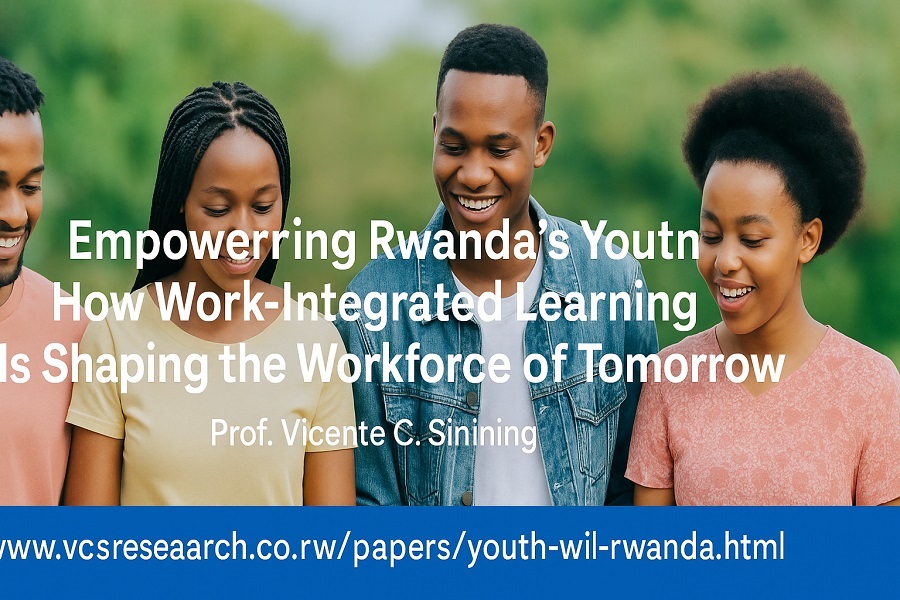
In today’s knowledge-driven economy, traditional degrees no longer guarantee employment. In Rwanda, a quiet yet transformative movement is gaining momentum—Work-Integrated Learning (WIL). As the country accelerates toward middle-income status, WIL emerges as a catalytic tool to harness the potential of its youthful population.
Rwanda boasts one of the youngest populations in Africa—a powerful demographic asset. Yet without experiential learning, that asset risks becoming untapped potential. The pressing question is: how can Rwanda empower its youth not only to secure employment but to drive innovation and economic growth?
Bridging the Gap Between Learning and Earning
A recent study by Prof. Vicente Sinining and Mr. Costase Nsengiyaremye (University of Technology and Arts of Byumba) reveals a compelling answer: integrate education with real-world application. WIL is more than internships—it embeds authentic work experiences within academic curricula. Through apprenticeships, project-based learning, and partnerships with industry, students don’t just study work—they experience it as part of their education.
“Work-Integrated Learning transforms passive learners into active problem solvers,” says Prof. Sinining. “It equips them not only with technical know-how, but also with the confidence to adapt and innovate.”
The Power of Practice: Building Skills for a Changing World
WIL fosters three essential competencies:
- Technical Proficiency: Students gain familiarity with tools and technologies directly aligned with industry standards.
- Problem-Solving Acumen: Facing real-world challenges develops both critical and creative thinking—far beyond what traditional lectures can offer.
- Adaptability: In an ever-evolving job market, WIL graduates are equipped to pivot, innovate, and lead with agility.
Lessons from Abroad, Tailored for Rwanda
Countries like Canada, Australia, and South Africa have successfully implemented WIL models, but Rwanda’s context demands a uniquely localized approach. The study emphasizes the importance of aligning WIL with national priorities, cultural values, and educational realities.
Interviews with educators, employers, and students revealed a common aspiration—meaningful, career-focused education. However, they also uncovered disconnects: employers seek job-ready graduates; educators want industry support without compromising academic depth; students crave relevance and pathways to real opportunities.
Designing a National WIL Framework
A successful national WIL strategy should include:
- Curriculum Integration: Embed WIL principles across all disciplines—from STEM to social sciences, agriculture to tourism.
- Industry Partnerships: Foster co-created opportunities with private firms, cooperatives, government agencies, and NGOs.
- Faculty Empowerment: Train instructors to facilitate and supervise real-world learning experiences.
- Monitoring and Evaluation: Establish mechanisms for tracking outcomes, collecting feedback, and ensuring quality assurance.
Cultivating a Culture of Innovation
At its heart, WIL is about entrusting youth with meaningful responsibility. It reframes students not as passive recipients of knowledge but as co-creators of Rwanda’s development journey. When given the tools and space to act, youth don’t just imagine a brighter future—they build it.
When Rwanda’s young people are given not just knowledge, but platforms to apply it, they don’t just dream of a better future—they become its architects.
This article is based on the academic paper entitled "Empowering Rwanda's Youth: Work-Integrated Learning as a Key to Sustainable Development".
Click here to read the full academic paper.


