Kenya: Grassroots Resilience
In rural Kenya, solar micro-grids have transformed local communities. Community ownership, vocational training, and PAYG models empower residents, turning them into energy stewards.
Articulating Ideas, Advancing Thought
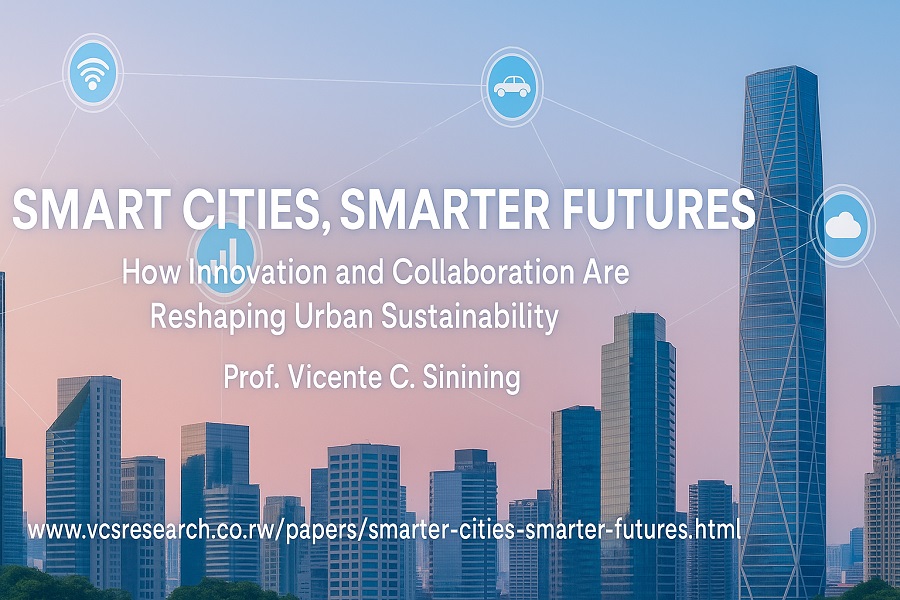
Urban areas across the globe are expanding at unprecedented rates. As cities grow, they face mounting challenges—from environmental degradation and infrastructure overload to social inequities. In this timely feature, Prof. Vicente C. Sinining explores how the strategic integration of technology and multi-stakeholder collaboration offers a bold path forward for sustainable urban development.
With 70% of the world’s population projected to live in cities by 2050, the stakes are high. Overstretched systems, pollution, and rising inequalities demand more than technical fixes—they require institutional intelligence. Prof. Sinining argues that sustainable cities must be built not just with smart technology, but with inclusive, adaptive governance.
Singapore exemplifies sustainable innovation through vertical gardens, water reclamation, and smart transport. Its success is rooted in policies that foster collaboration and public engagement, highlighting the importance of marrying innovation with inclusivity.
In rural Kenya, solar micro-grids have transformed local communities. Community ownership, vocational training, and PAYG models empower residents, turning them into energy stewards.
Vietnam’s offshore wind projects, enabled by state support and international finance, demonstrate how large-scale systems can reduce emissions and stimulate green jobs.
Prof. Sinining emphasizes interconnected leadership. From NGOs and policymakers to engineers and citizens, everyone plays a role in building resilient cities. These relationships are not linear—they are dynamic, mutually reinforcing, and deeply contextual.
The path forward involves integrating emerging tools like blockchain and AI, prioritizing energy equity, and fostering cross-border partnerships. Sustainable urbanization must be not only smart—but just and inclusive.
“Innovation without inclusion is fragility in disguise,” Prof. Sinining writes. His study underscores the need for an urban future that is equitable, collaborative, and contextually intelligent. From decentralized solar cooperatives in Africa to government-led wind energy in Asia, these models provide a blueprint for transformation—if we choose to learn from them.
This article is based on the scientific research entitled "Innovating Urban Sustainability: Strategic Integration of Technology and Stakeholder Collaboration to Address Challenges in Rapidly Urbanizing Cities".
Click here to read the full academic paper.


